
NBS-nytt
15.11.2016
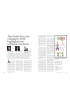
The 108th Nobel Prize for Chemistry, awarded by the Swedish Academy in 2016, celebrates synthetic organic chemistry. The academy's choice of Jean-Pierre Sauvage from the University of Strasbourg, Sir J. Fraser Stoddart from Northwestern University, and Bernard L. Feringa from the University of Groningen accentuates accurate molecular design, meticulous organic synthesis and careful
...characterization of function by diverse analytical techniques. Afair share of earlier Chemistry Nobel Prizes were honouring outstanding achievements in organic synthesis, most recently in 2010 the palladium-catalyzed cross couplings developed by Heck, Negishi and Suzuki, and in 2005 the olefin metathesis method of Chauvin, Grubbs and Schrock. In 2016, the focus was clearly on particularly exciting capabilities of man-made molecules, ingeniously designed and created by the laureates and their teams. These researchers are the champions of synthetic molecular machines - functional molecules that do not catch the eye due to their chemical and physical properties, but because of their ability to exhibit quasi-mechanical movements in response to a specific stimulus. The structures feature mechanically interlocked architectures, molecules with side groups that keep other, not chemically connected molecules in their place. And voila, since no chemical bonds are involved, the entrapped molecules are able to move in response to external signals.
The majority of the known molecul
Gå til medietThe majority of the known molecul