
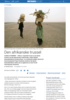
Hun peker på pandemier, terrorisme og masse-migrasjon med utgangspunkt i Afrika.
- Afrika representerer allerede en direkte trussel mot global stabilitet og denne trusselen vil bli forsterket av klimaforandringer, skriver hun.
Det er ti år siden Dambisa Moyo skrev sin kjente bok «Dead Aid». Den var et kraftig oppgjør med internasjonal bistand til Afrika. Et hovedpoeng i boka var at bistanden hadde sementert Afrikas rolle som verdens problembarn, i stedet for å hjelpe kontinentet til å utnytte sine muligheter.
Dambisa Moyo mener at Afrikas problemer ikke lenger vekker interesse og at omverdenen ikke behandler verdensdelen som en «voksen». Hun sammenligner denne mangelen på engasjement med situasjonen etter første verdenskrig, hvor korrupsjon, politisk ustabilitet og ekstremisme i Tyskland førte til en ny krig.
On Point: Long View
The African Threat
By Dambisa Moyo
NEW YORK - If the world never had to hear about Africa again, would anyone care? Setting aside Africa's cultural contributions, I suspect that for many people the honest answer is "no."
Ten years ago, in my book, I highlighted how a narrative backed by international aid policy cemented Africa's status as the world's problem child, rather than one destined for greatness.
Over the years, false starts on the continent have led to cynicism and despair. Once a repository of progressive aspiration, Africa has become the source of some of the greatest threats to the global economic order. Rather than capitalizing on opportunities, international engagement is increasingly focused on mitigating risks.
But mitigation is not enough. The world needs to engage and help solve Africa's problems, which, sooner rather than later, will become global problems.
To be sure, economic theory suggests that Africa should be growing rapidly. The continent is that China, India, the contiguous United States, Japan, and most of Europe could all fit within its borders. Africa also contains, making it the region best positioned to feed a burgeoning global population, by the United Nations to reach 11 billion by the end of this century.
Moreover, Africa is home to,,,, and. African countries lead in the production of industrial metals such copper and iron ore. And, all told, Africa controls approximately one-third of the world's remaining mineral resources.
Finally, with a median age of 19.5, Africa has the world's youngest and labor force, ahead of even. The continent is already home to, and that number will continue to grow.
From Promise to Perdition
And yet, despite its many advantages, Africa has failed to turn its economic potential into long-term growth and prosperity. Economic development has repeatedly stalled as a result of resource mismanagement, flawed - if not corrupt - asset allocation, a lack of innovation, myopic leadership, resistance to adopting proven growth strategies, and a massive failure of coordination across the region, owing to an inability to organize collectively. At the same time, disease, war, and persistent poverty continue to limit Africa's prospects.
According to Transparency International's of 180 countries and territories around the world, Sub-Saharan Africa was the world's single most corrupt region as of 2017. The World Health Organization reports that communicable diseases claimed there in 2015, accounting for a majority of the region's deaths.
Moreover, the Institute for Security Studies reports that of the world's armed-conflict incidents in 2016 occurred in Africa. And the World Bank estimates that in 2013, Sub-Saharan Africa contained of the world's poorest people, with 389 million people living on less than $2 per day. In 2016, Africa accounted for a paltry,, and just (FDI).
It is little wonder that the world has lost hope that Africa will ever escape poverty, corruption, and war. Worse still, it has become acceptable in some quarters to dismiss and disparage Africa and its people. With the notable exception of China, most world powers simply do not have much of a stake in the continent. When Western countries do show concern, it is usually more in response to China's growing influence in the region than anything else.
How the West Washed Its Hands
Historically, the international community has pursued a variety of strategies for engagement with Africa. In the wake of colonialism, world leaders believed that widespread growth would eliminate poverty on the continent within a generation and supplant despair. In 1960, US President Dwight D. Eisenhower Africa as "rich in human and natural resources and bright with promise."
Instead, economic progress ground to a halt in the 1970s, with Sub-Saharan Africa's annual growth rates plummeting from around to just. Soon thereafter, the International Monetary Fund and the World Bank started introducing stabilization and "structural adjustment" programs geared toward fostering trade, encouraging private-sector devel